Wednesday, Dec 15, 2004: We disembark at Jhansi railway station and take the shuttle taxis to our Hotel at Khajuraho. It's about a 4 hr drive.
The Hotel seems nice enough. Dinner done, some of us -- Patta, Liat, Nori, Sameer and myself -- end up going for a walk along the main road leading to the Western group of temples, which are the main group apparently. The temples close at night so all we get is an outside glimpse of the silhouettes, which looks promising.
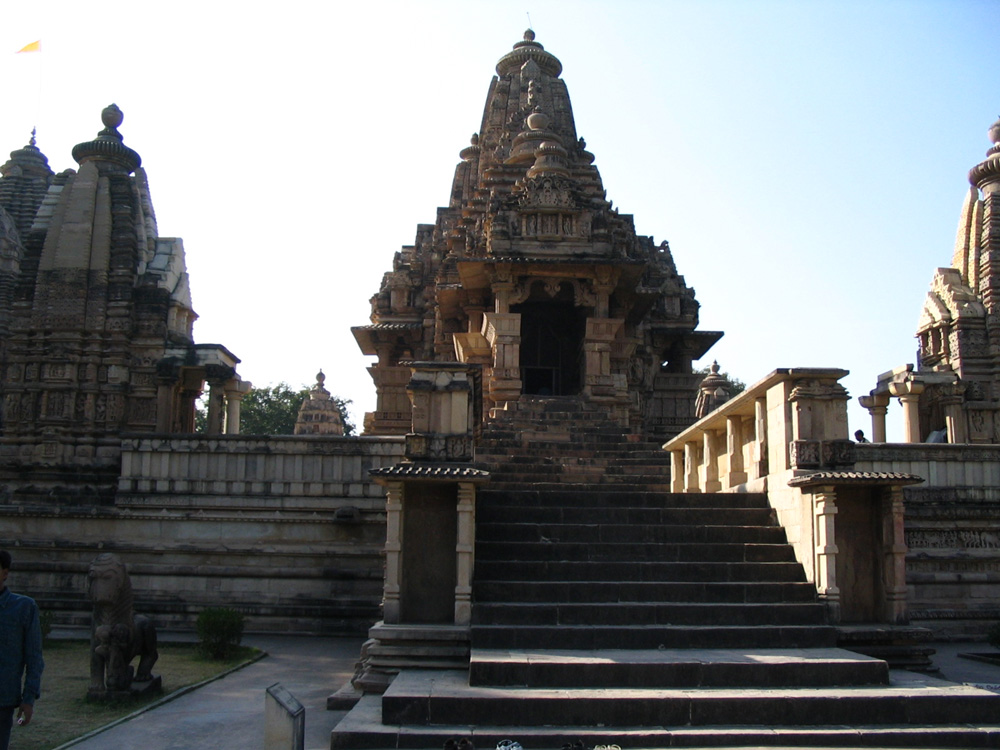
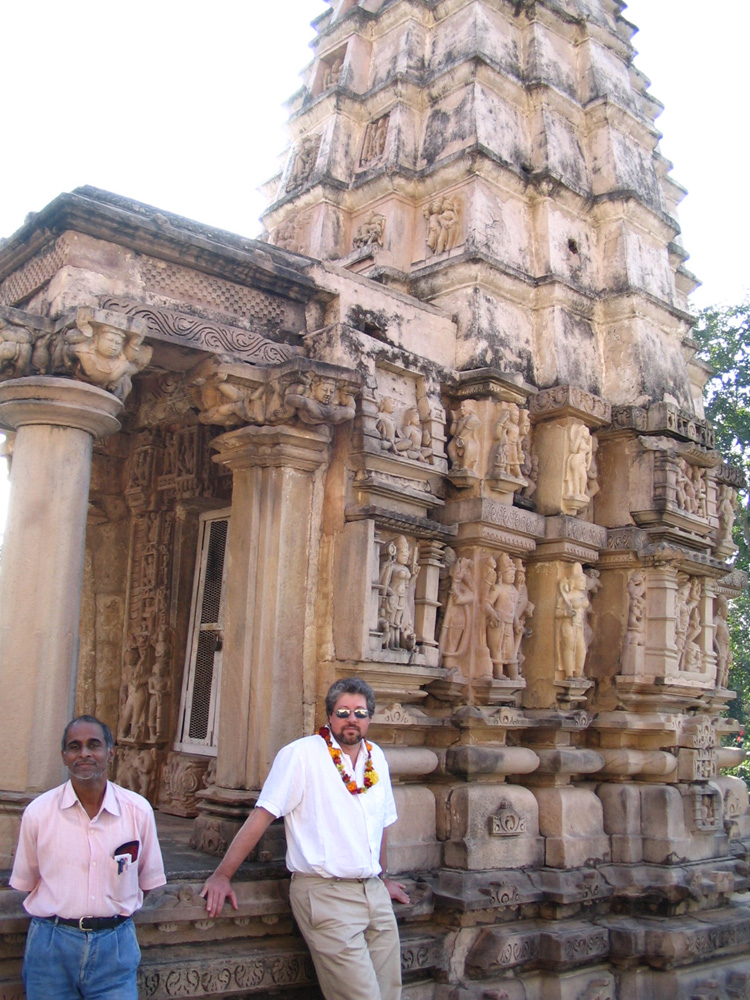
Friday, Dec 17, 2004: The afternoon's off so a group of us decides to take off for a better tour of the Temples in the West (the main collection). Time thins out our group which eventually reduces to Sunil Mukhi, Erik Verlinde, Sameer Murthy, Indrajit Mitra, Liam McAllister and myself. At least in part, this seemed to be catalyzed by the first guide we landed, who seemed intent on driving home the erotic details (and those alone) of the sculptures, which beyond a point got pointless.
Anyway our second guide seemed a bit broader in perspective, albeit a bit on the moralistic side himself. Still, he wasn't devoid of content so it wasn't too bad a deal. Anyway he seemed to have his own theories on the sculptures in themselves as well as with the history of Khajuraho in perspective. For instance, something new was his theory on the derivation "Khoj raah" (in search of the Path, presumably to Truth) of the word Khajuraho, rather than the more common one, stemming from the presence of the Khajur (date palm) trees found in the area.
|
|
|
|
|
|
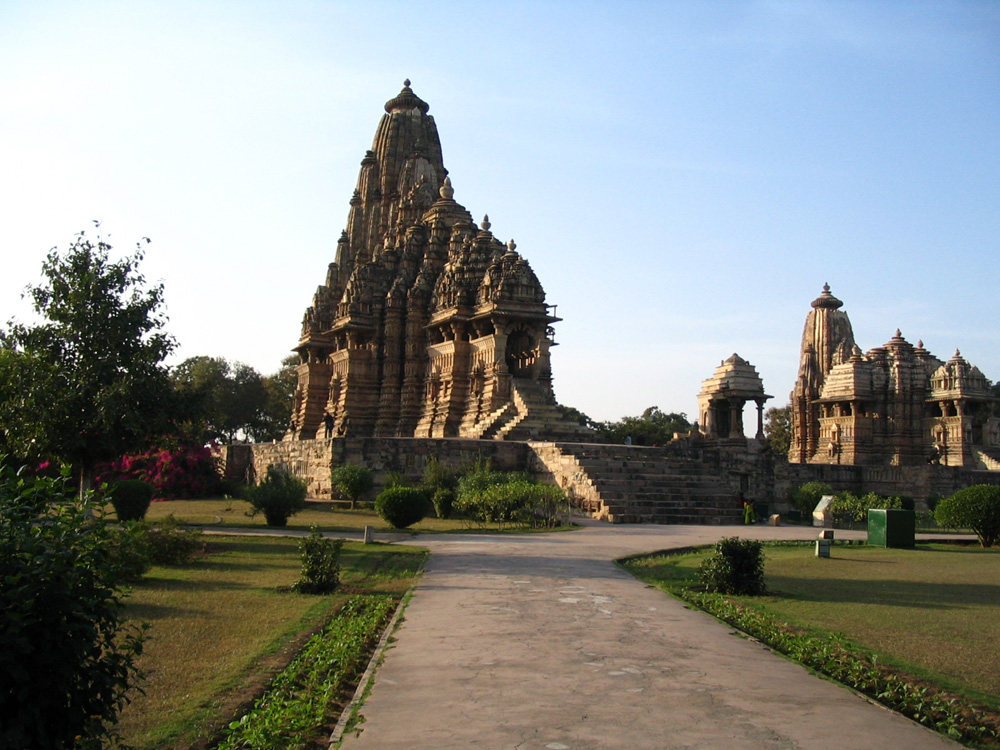
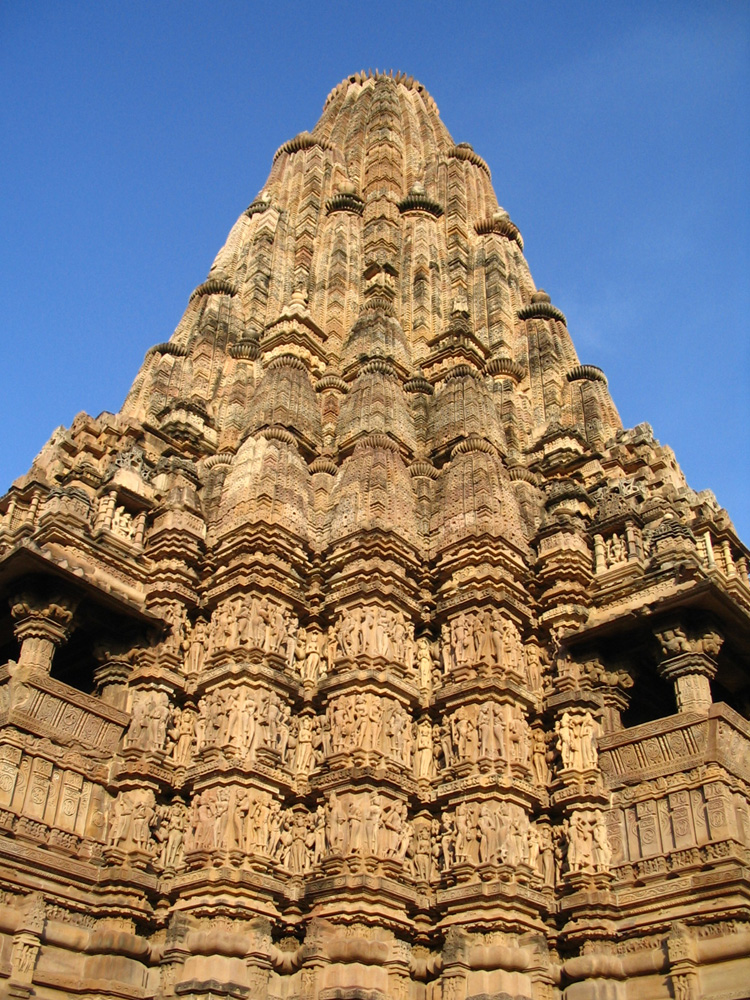
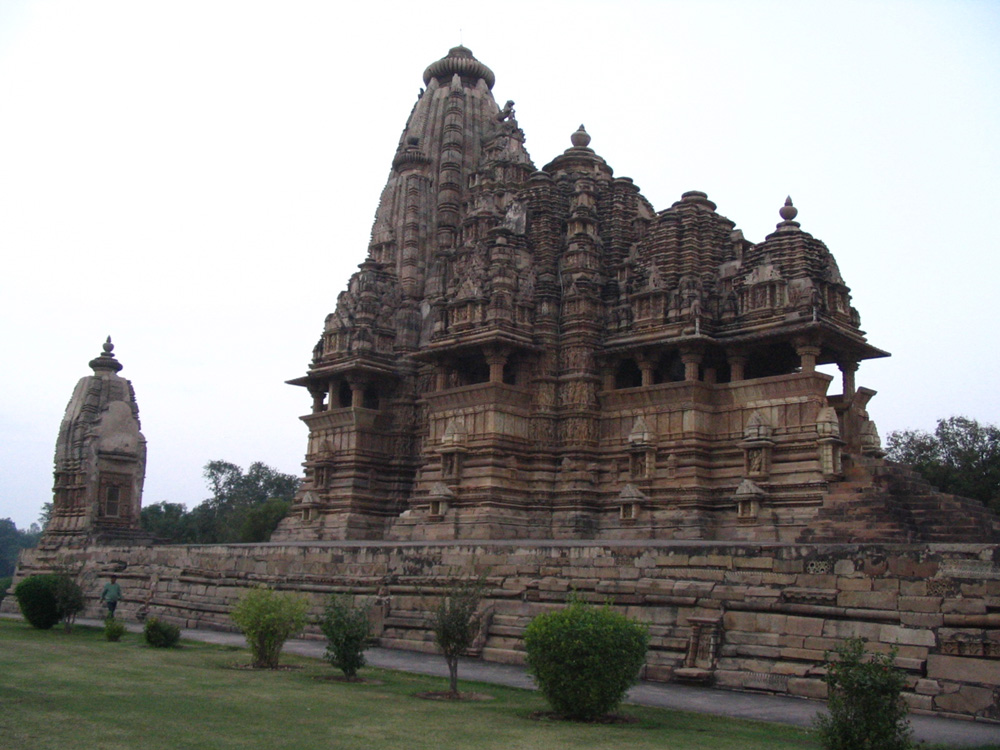
Most of the sculptures and the temples in Khajuraho date back to between about 850 and 1100 AD, during the reign of the Chandela dynasty. At least the Western group of temples seem distinctly Hindu in origin, with the three main temples being dedicated to Lakshmana, Vishwanath and Khandariya Mahadeva [perhaps it is noteworthy that the Adi Sankaracharya had just revamped Hinduism in large parts of the Indian mainland, stretching from Kerala to Kedarnath, sometime around 800 AD]. There are other temples in the area, primarily of Jain origin, but at some of those temples, we heard that the main deity/idol was in fact Shiva originally, and had been replaced with Mahavira as late as about a hundred years back. For temples that are of order a thousand years old, the sculptures seem quite far from dilapidated. Story goes that after the Chandela kingdom declined around 1300 AD, Khajuraho shrank away into oblivion till its discovery around 1838 by a British officer who happened to be surveying the area. Subsequently the place has of course been revived.
 |
 |
 |
 |
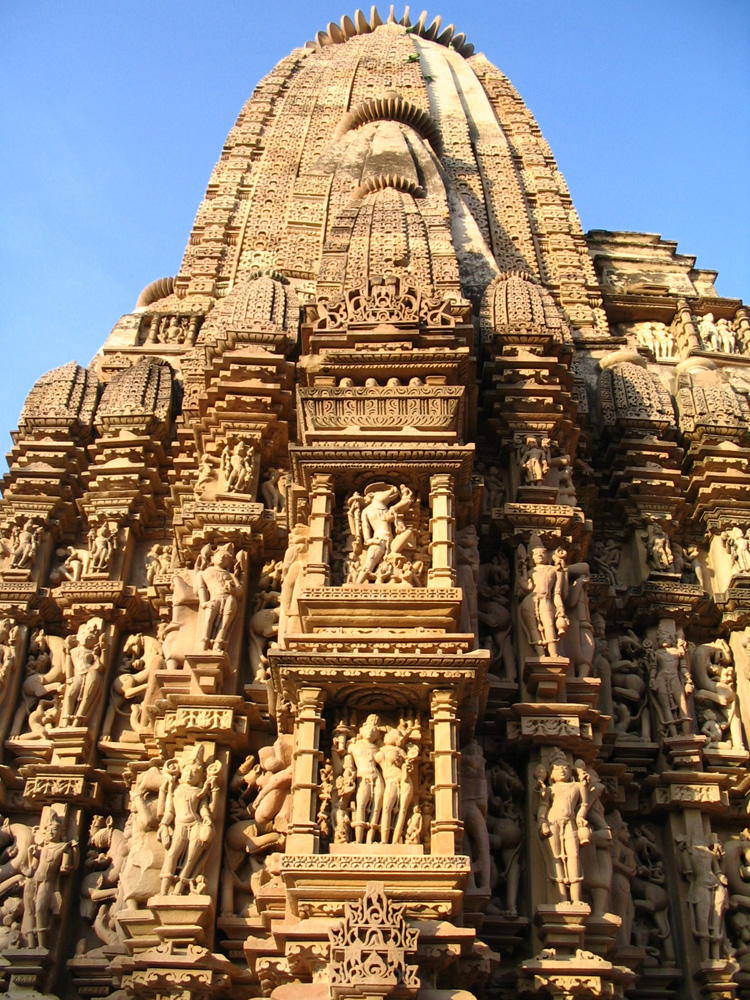 |
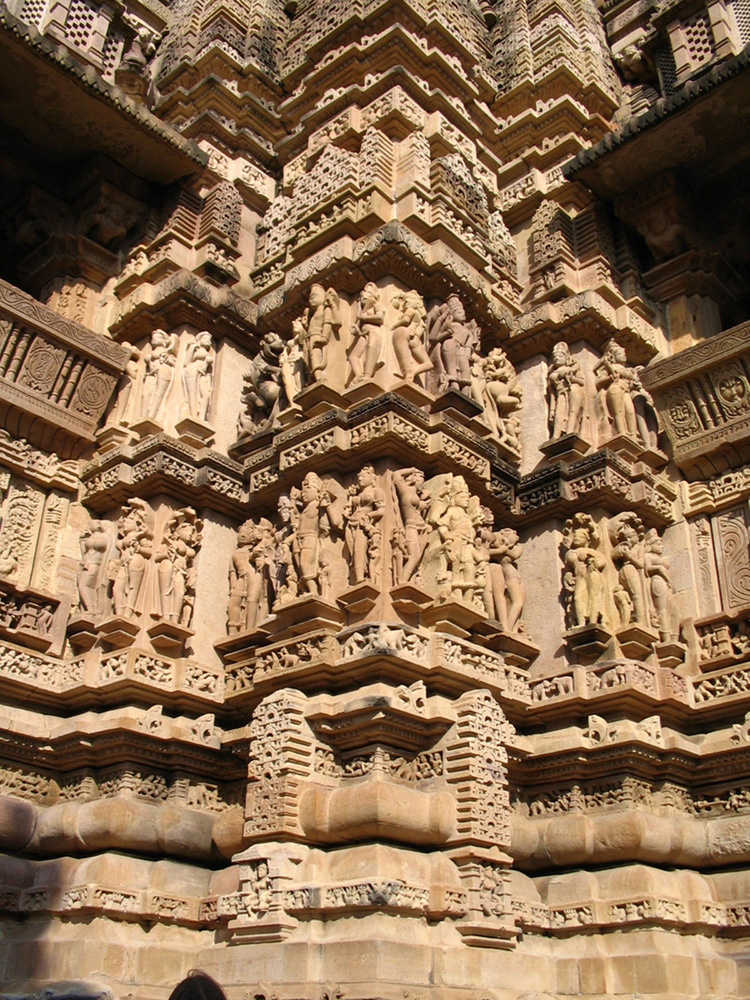
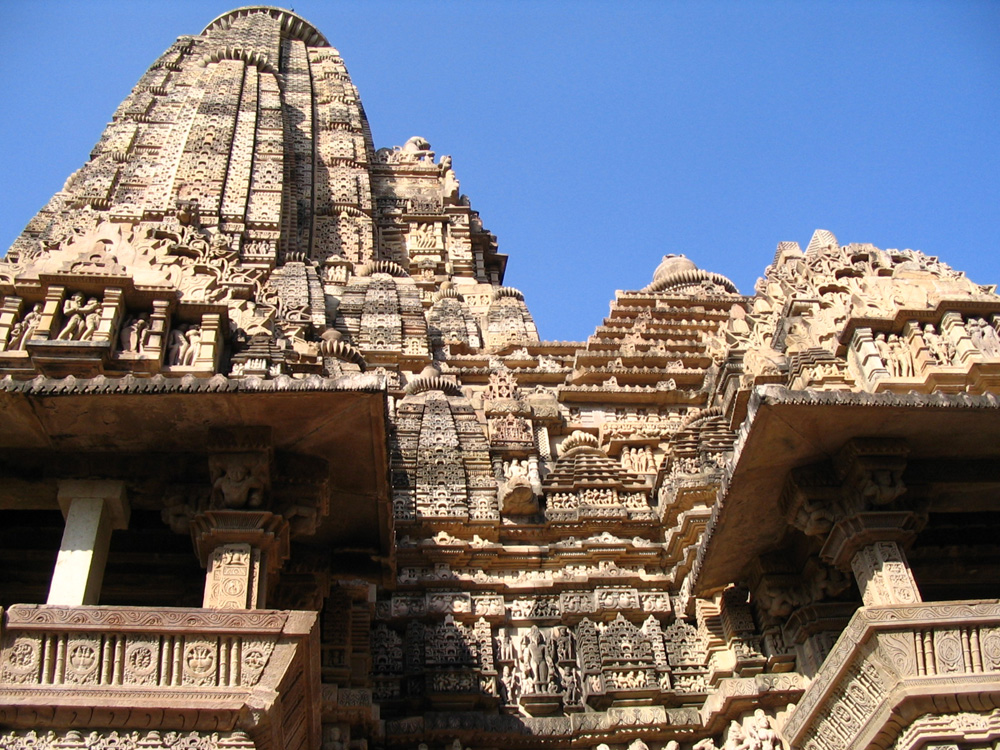
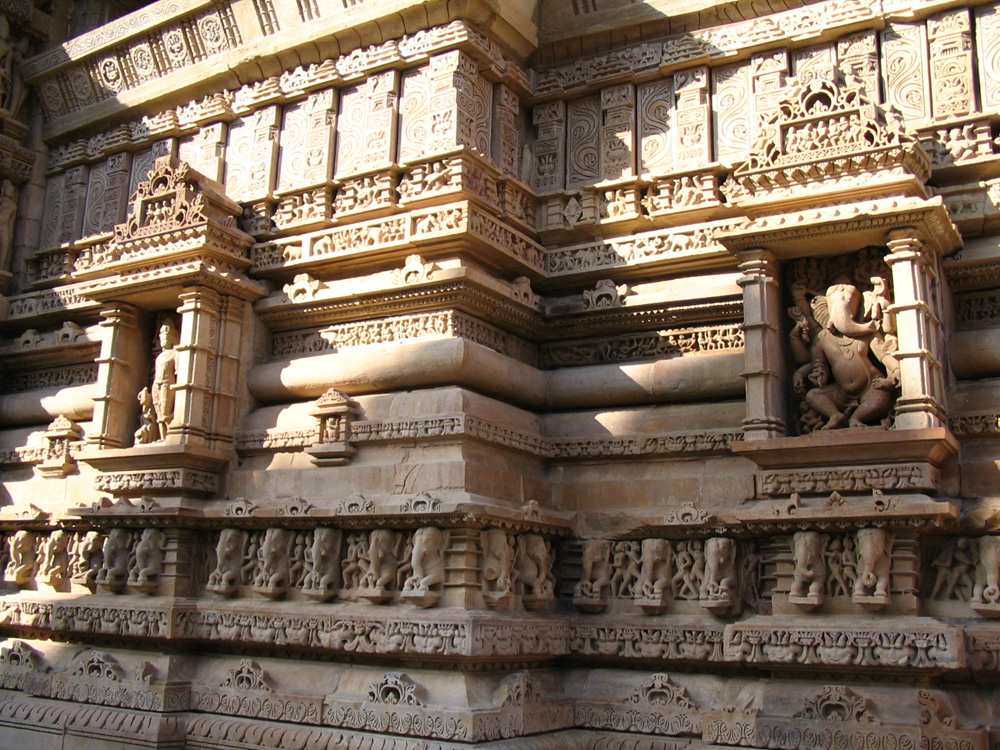
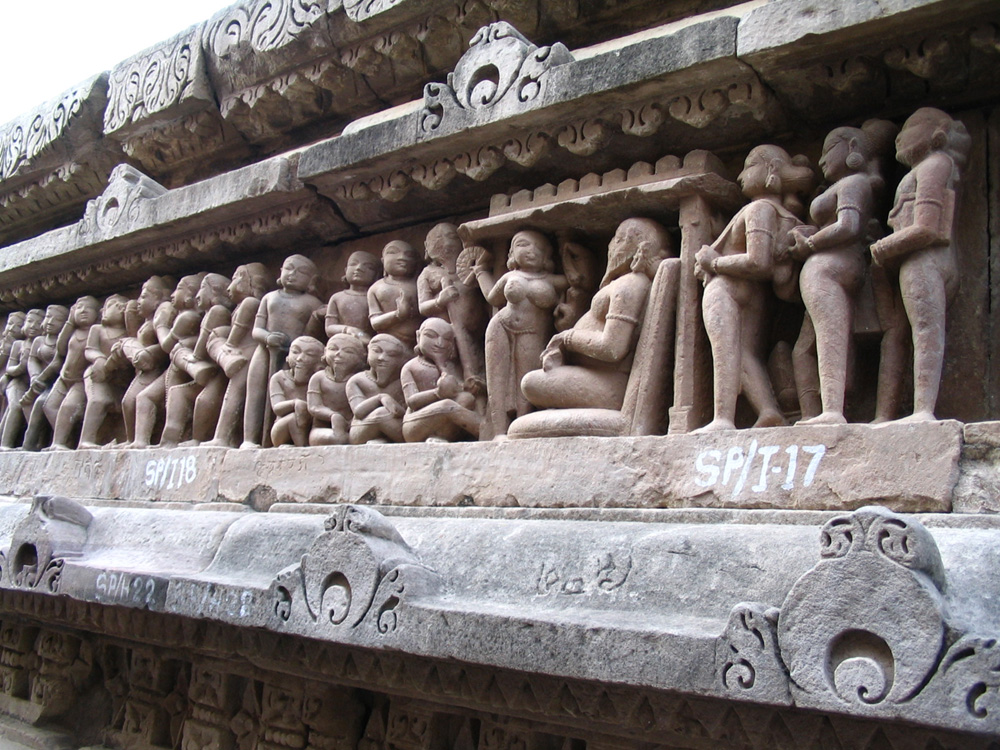
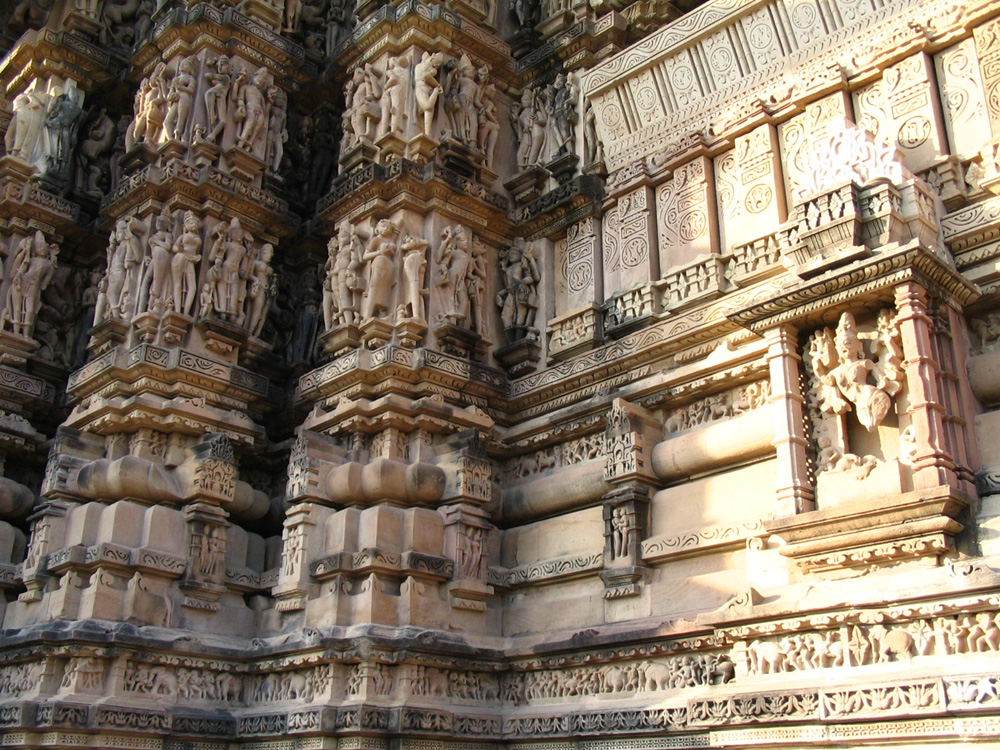
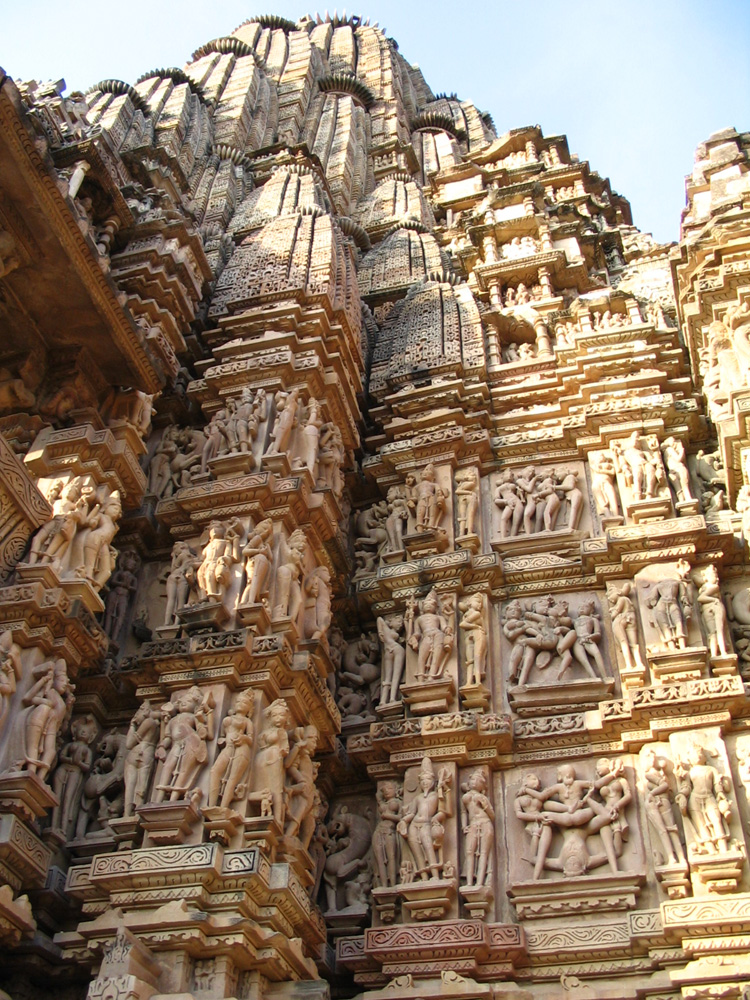
The sculptures seem quite wide-ranging in theme, from myriad facets of routine life (for instance, ladies preening themselves, reading (presumably love) letters, adorning themselves and so on) to wars with armies containing elephants, horses and suchlike to ceremonies like marriages to court scenes in Kingdoms to couples in love to explicit erotica. A curious scorpion appears carved on one of the legs of some of these damsels. Other curiosities include gryphon-like creatures, often with the body of a lion (or some other predator) and the head of a tiger, human, elephant, wild boar (Varaha) and so on. Perhaps something else noteworthy (at least to me) is the fact that in most of these temples, the erotic sculptures seem to only exist on the outer walls of the temples while the inner chambers have nearly none such and the innermost sanctum sanctorum contains but the statue of the main deity -- it is tempting to speculate some kind of hierarchy in the way the themes of the sculptures were organized when created. The sculptures, primarily consisting of sandstone, appear rather intricate architecturally -- in some ways, the structure of the temples, as well as the sandstone used, are reminiscent of the Konarak Sun temple in Puri further East and the Thanjavur temple further South (circa Chola dynasty). The expressions on the human figurines seem to exhibit a whole range of emotions and appear to exude life.
 |
One wonders what the circumstances prevalent then in this region were, that precipitated the creation of the erotic themes among the sculptures here, especially since such themes do not seem to exist elsewhere in India (save a few in the Konarak Sun temple near Puri) -- most other temples in India, while also rife with impressive architectural grandeur, have religious themes. Among the theories propounded can be found those that suggest that the prevalent society then was rather uninhibited, and those that suggest the revival of Hinduism in the then perhaps decadent society, and various others. As for fact, well, who knows ...
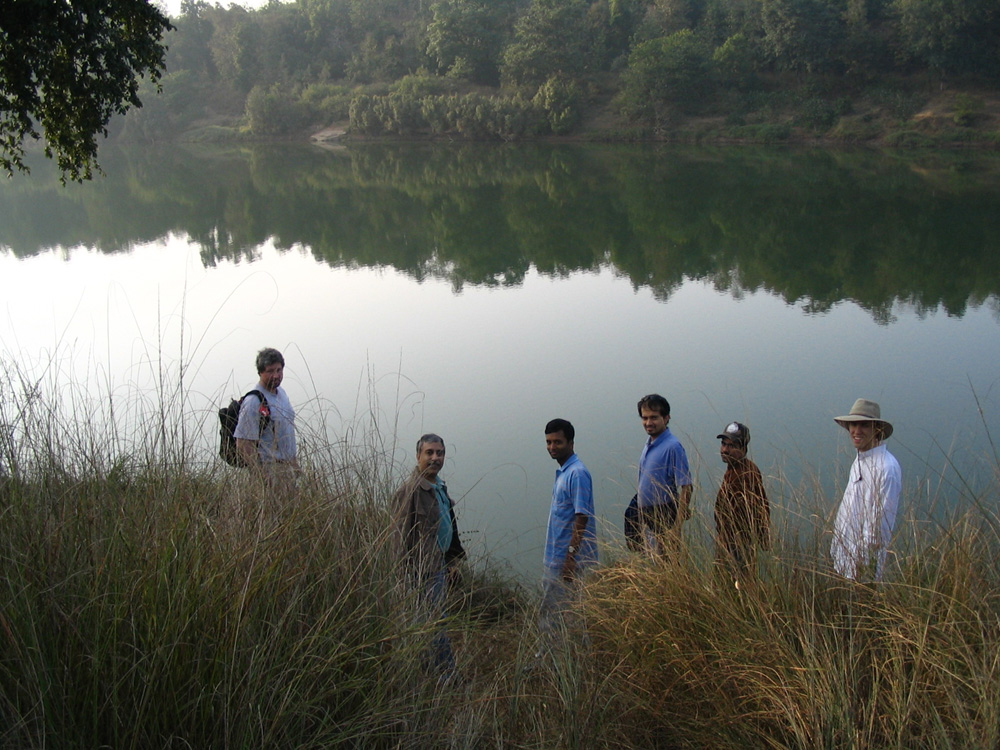
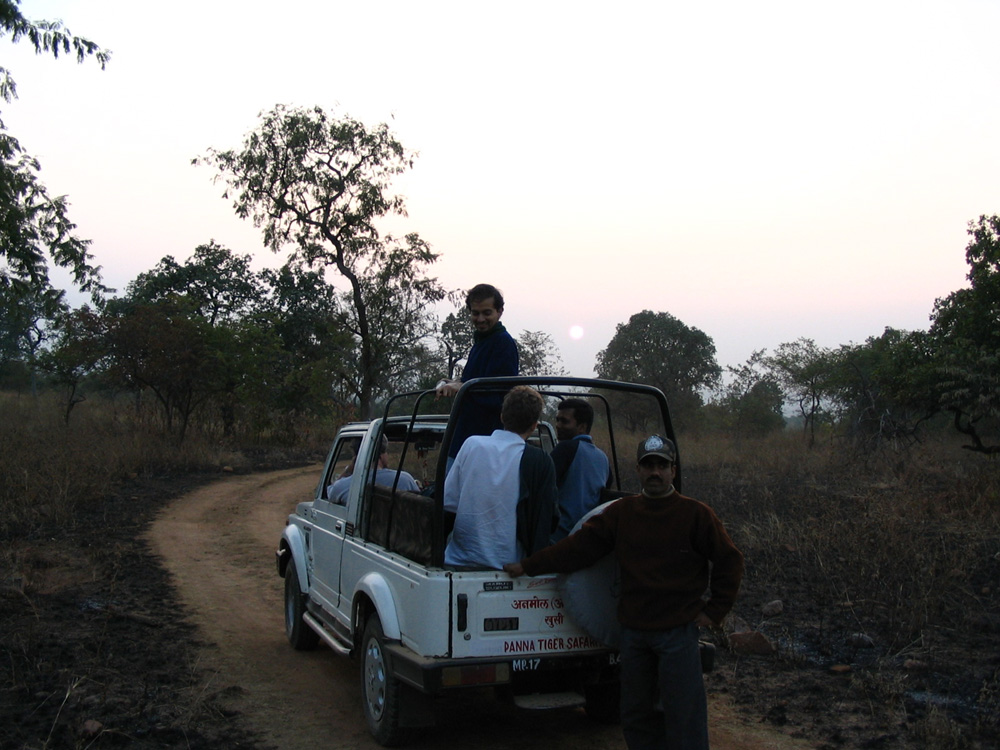
Sunday, Dec 19, 2004: The same six of us head off for Panna Tiger Reserve in the afternoon, our expedition being spearheaded by fearless leader Sam, who presumably decided to follow in the footsteps of the Original Fearless Leader, R. Gopakumar, whose wisdom and tutelage guided us through the Path of Philosophy in Kyoto. We head off in an open air jeep which promised great charm. And of course great access to any predator that decided human flesh was the way to go. Anyway having decided to sally forth unbridled by such trifles, we do just that. Panna is about a half hour drive from Khajuraho. En route to Panna, we stop at Pandava Falls that are a mere whimper at this point. And then we enter Panna -- it's about 3 pm. We pick up a guide at the entrance who rides the jeep along with the rest of us. The sun isn't too intense at this point, nor is it chilly, so the drive is quite pleasant.
The first thing that becomes conspicuously noticeable is the smell of the forest, something quite different from anything one can smell in Bombay at large, or any other city for that matter. Furthermore, it's noteworthy that this is not anything as domesticated as a zoo, but a verdant pristine wilderness. We're driving on a rough path, essentially just a loose-soil-path. Now and then one sees groups of people, typically women, apparently at work in the forest. The area covered by Panna is about 500 sq.km. apparently, quite a large region. We reach the banks of Ken river that flows through the Reserve -- there's this misty feel to the place at least in the distance. And then we are informed that a gharial (a certain Indian crocodile species) has been spotted sunbathing. And we hasten off to see it, and sure enough, there it was. Also can be seen some Langur and a cormorant. We turn off, get back into the jeep and drive off.
 |
 |
 |
 |
 |
 |
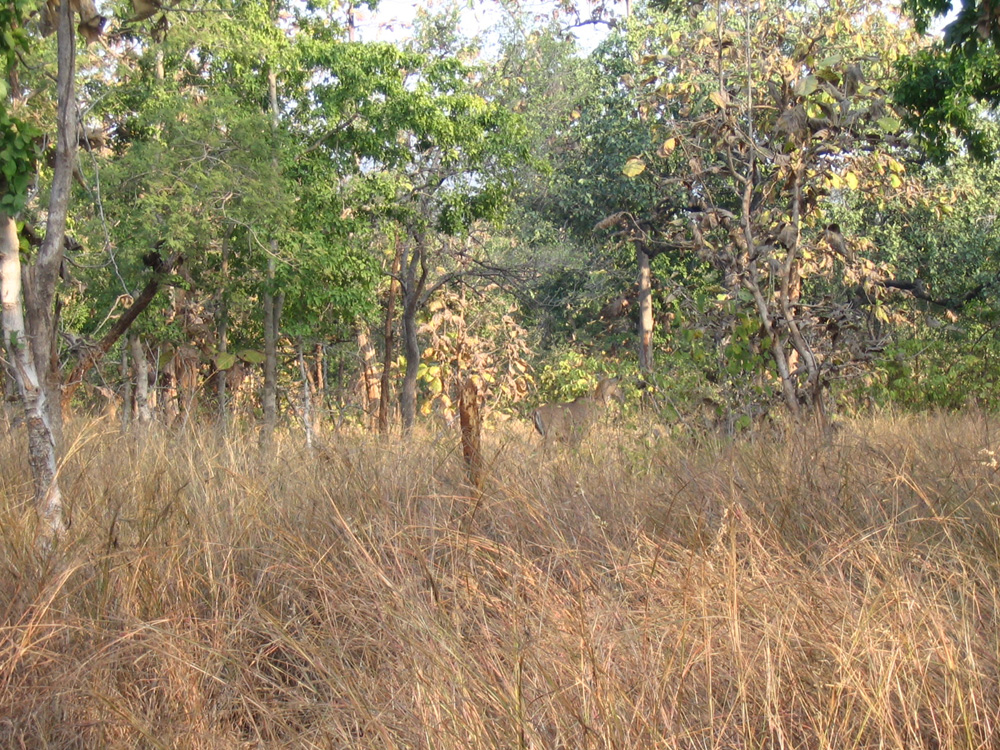
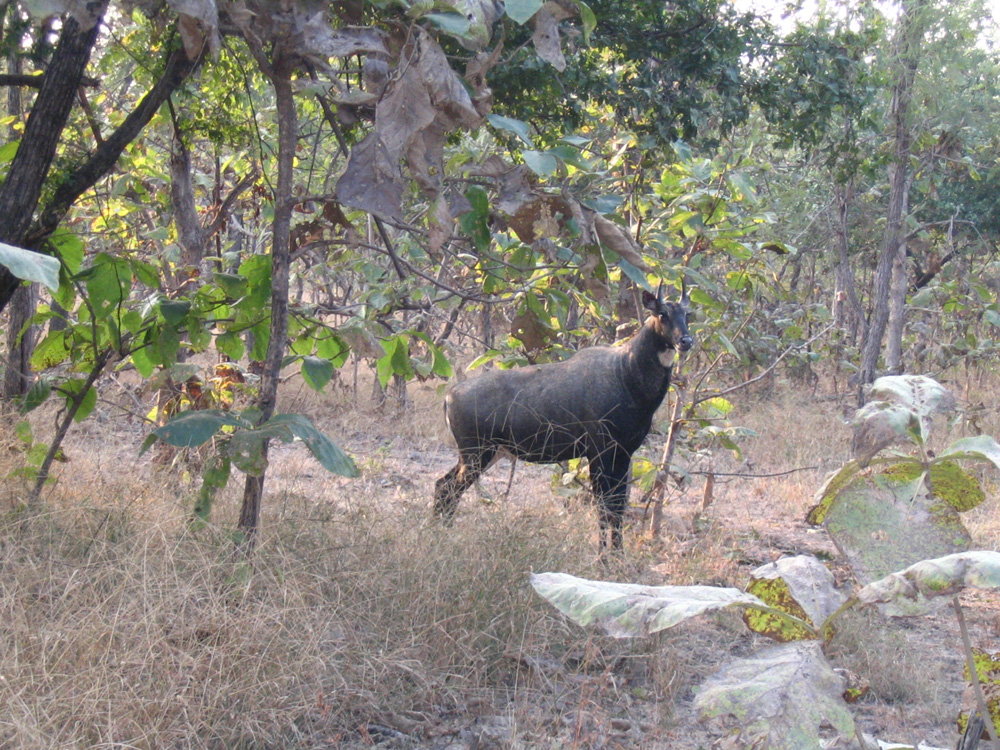
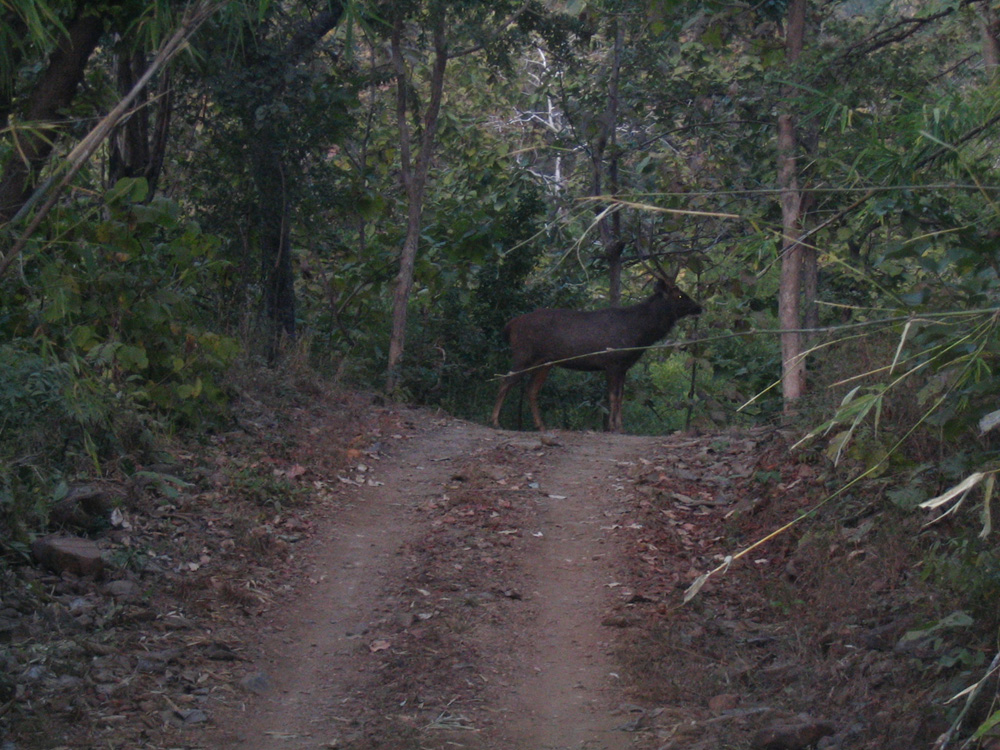
It's getting late in the afternoon and the air is slightly cooler. Now we see some female Nilgai (a largish antelope). Later we also see a big male. There are langur all over the place. We then spot some sambhar deer at a waterhole, one large male with a nice set of antlers.
We drive on. Now we're quite into the thick of the wilderness. At the sound of a langur's cry, our guide informs us that perhaps this is the sound of a tiger being spotted. We drive a bit further, towards the cry, then stop the jeep. You can actually hear the silence here. Silence that can come across as somewhat chilling and ethereal. It's as if one has been transported to someplace far far away from any human habitation and civilization. And then the sound of the langur's cry pierces through again, the ambient silence considerably amplifying the cry. Some of us are now standing in the open air jeep, with bated breath, looking around to see if there's a tiger lurking nearby, camouflaged by the tall grass. Amidst the silence, one cannot but feel a slight shiver running down one's spine, in anticipation of the low growl of the predator. [On a rereading, I must say that this verbal blurb is woefully inadequate as a description of what we actually felt there at the time.]
Some sambhar appear nearby. Some of them walk by, past the jeep, across the path towards the grass on the other side of it. It's close to sundown now. The light is dimming. And it's getting chilly. I forgot to bring a jacket and can now feel the chill through my T-shirt. It's still quite pleasant, must say.
We've more or less given up on spotting any tiger now. And decide to head back, it being close to closing time anyway. On the drive back, we pause to catch a glimpse of the sunset over the forest. The sun is a shimmering reddish fireball now, immersed in a pale sky. We spot a few more sambhar, one with rather impressive antlers.
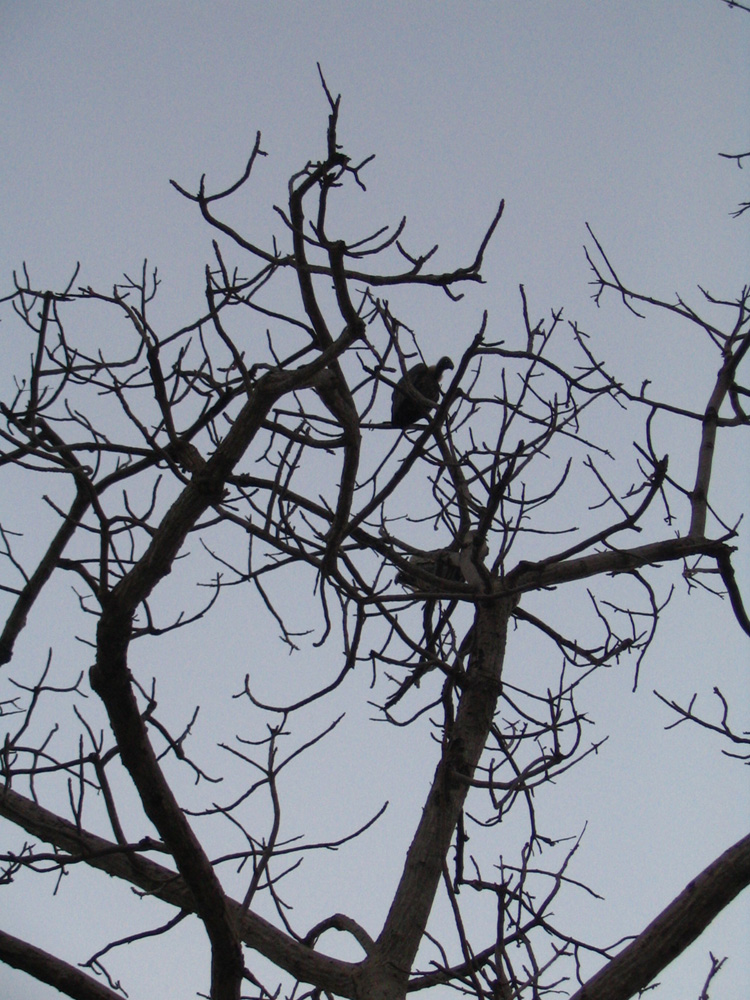
"Stop!". We've just spotted a couple of vultures seated on a leafless silhouette of a tree. Makes for a good photograph, kindof eerie.
The drive back from Panna to the Hotel is uneventful -- by now, maybe my face is so visibly white from feeling chilly (or maybe I've been whining away merrily and it got out of control at some point..) that Sunil decides to give me his jacket, which keeps me warm through the drive. The evening features a banquet as part of the Strings Workshop. And a party...one of the highlights of which was this wild frenetic dance duet between Andy Strominger and Gary Gibbons!! man..that was some party..
Tuesday, Dec 21, 2004: Indrajit and I go tour the Jain temples (where we run into Sam), which are nice but less impressive (I think) than the Western group. We also see the Duladeo (Shiva) temple nearby.
Wednesday, Dec 22, 2004: A brief (as in, 10 minutes!) jaunt to the Vishwanath temple in the main group. Nice..
Thursday, Dec 23, 2004: Time to bid adieu..amidst all that fog.. farewell Khajuraho....
Images: Copyright © K. Narayan, Dec 2004